
Bailey’s Tailgate Talk: Real Recovery Slings. Real Break Test. Real Results.
What can worn recovery slings actually tell you after years of hard service? Appearance can tell you that rigging has seen work, but it cannot tell the whole story of what is happening inside the sling. That is why Bailey’s asked a longtime customer to send back several heavily used slings and put them on a test machine instead of guessing.
The goal was not to prove that worn rigging should stay in service. It was to learn from real recovery equipment that had been working since 2023 and share what those destructive tests revealed.
Real Recovery Slings After Years of Service
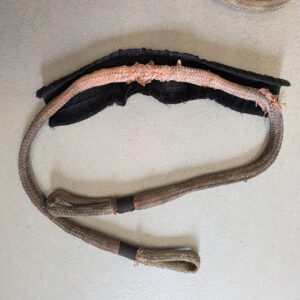
Everything Autos in Tennessee sent Bailey’s slings that had been in regular service since 2023. These were not slings pulled from a shelf or used only in controlled demonstrations. According to the Tailgate Talk, they had seen creek and ravine recoveries in the mountains along with other challenging recovery work.
By the time the slings came back, they looked rough – close to done. That made them useful examples for a simple question: after years of demanding service, what would happen when they were taken all the way to failure on a test machine?
Recovery Sling Break Test Results
Bailey’s tested two heavily used 3/8-inch CSP Slings and two heavily used 5/16-inch Grommet Slings. The supplied script does not state the original minimum break strength value, so the most useful comparison here is the actual result from each tested sling.
| Sling tested | Size | Break-test result |
| CSP Sling #1 | 3/8-inch | 13,270 lb |
| CSP Sling #2 | 3/8-inch | 15,330 lb |
| Grommet Sling #1 | 5/16-inch | 14,960 lb |
| Grommet Sling #2 | 5/16-inch | 16,580 lb |
All four slings maintained substantial breaking strength after years of regular service. But that statement needs an important boundary around it: these results apply only to the four slings Bailey’s tested. They are not a replacement rule, an inspection standard, or a reason to assume another worn sling will perform the same way.
Does a Strong Break Test Mean a Worn Sling Is Safe?
That is specifically not the takeaway. A destructive break test tells you what happened to the sling on the machine after its service life. It does not give an operator permission to keep questionable rigging in service.
The more useful lesson is that appearance alone cannot tell you everything happening inside a sling. Materials, design, and craftsmanship are decisions made before the first recovery, but their effects continue through the sling’s working life.
For operators, the practical message remains straightforward: respect your rigging, inspect it, and replace it when it is time. Do not use these individual test results as a reason to extend the service life of worn recovery rigging.
How Bailey’s Recovery Slings Behaved at Failure
The break numbers were only part of what Bailey’s wanted operators to notice. During the destructive tests, the CSP and Grommet Slings stayed together at failure.
Bailey’s CSP and Grommet Slings are built as completely protected slings. In this testing, that construction helped keep the sling contained when it failed. The Tailgate Talk identifies that containment as an important safety characteristic and gives operators another detail to watch in the break-test footage – not just the number on the machine.
Why Recovery Sling Construction Matters
You cannot build quality into a sling after it has already been put to work. The materials, construction, design, and craftsmanship are established before that first pull or recovery ever happens.
That does not make any sling indestructible, and it does not eliminate the need to inspect and replace rigging. What these four used slings offer is a real-world look at equipment that had already spent years doing demanding recovery work before it reached the test machine.
A special thanks goes to Everything Autos for sending Bailey’s the used slings so the results could be studied and shared with the towing and recovery industry.
One More Test Worth Watching For
While the test machine was running, Bailey’s was also evaluating new materials. One of those materials did not fail during the test described in the Tailgate Talk – instead, it began damaging the test bed. Bailey’s has not identified that material yet, so there is no conclusion to draw from it here. It is simply something to watch for in a future Tailgate Talk.
What These Recovery Sling Tests Teach Us
A worn sling can have a long story behind it, but you cannot read that entire story from the outside. These tests showed what happened with four specific Bailey’s slings after years of regular service. They did not establish that worn slings are safe to continue using.
For towing and recovery professionals, the point is to understand what the test actually demonstrates: quality begins with how rigging is built, appearance is not the whole picture, and inspection and timely replacement still matter.
Thanks for checking out Bailey’s Tailgate Talk — where cutting corners ain’t part of the job.
A special thanks goes to Everything Autos for sending Bailey’s the used slings so the results could be studied and shared with the towing and recovery industry.
Bailey’s Tailgate Talk videos are posted on Bailey’s Towing Accessories, Inc. social media pages. Make sure you’re following us to stay updated!
The footage makes this discussion easier to understand because you can watch both the loads at failure and what the slings do afterward. Watch the corresponding Bailey’s Tailgate Talk: Real Recovery Slings. Real Break Test. Real Results.
