
Bailey’s Tailgate Talk: The Connection Changes Everything Part 2
The same shackle can produce very different results depending on the rigging connected to it. That’s why understanding rigging efficiency comparison is important when choosing equipment for towing and recovery.
In Part 1, we discussed working load limits and rigging connections. We explained why two assemblies with the same rating may perform differently on the same connection.
Now, Part 2, takes that conversation further.
This time, Bailey’s compares chain, wire rope, an HMPE eye-and-eye rope sling, and an HMPE grommet rope sling.
The connection stays the same. However, the results can change depending on the material and construction.
Why D:d Ratio Matters in Rigging Efficiency
A sling or rigging tag gives you the working load limit, but it does not tell you how every type of rigging responds to every connection.
The diameter of the pin, hook, shackle, or other connection point changes the bend the rigging must make.
That is why D and d is not just a synthetic rigging topic. Chain, wire rope, polyester, HMPE, and synthetic round slings all have to interact with connection points.
What changes is how each material and construction responds.
As a result, understanding the complete rigging setup is important.
Wire Rope Efficiency at Different D:d Ratios
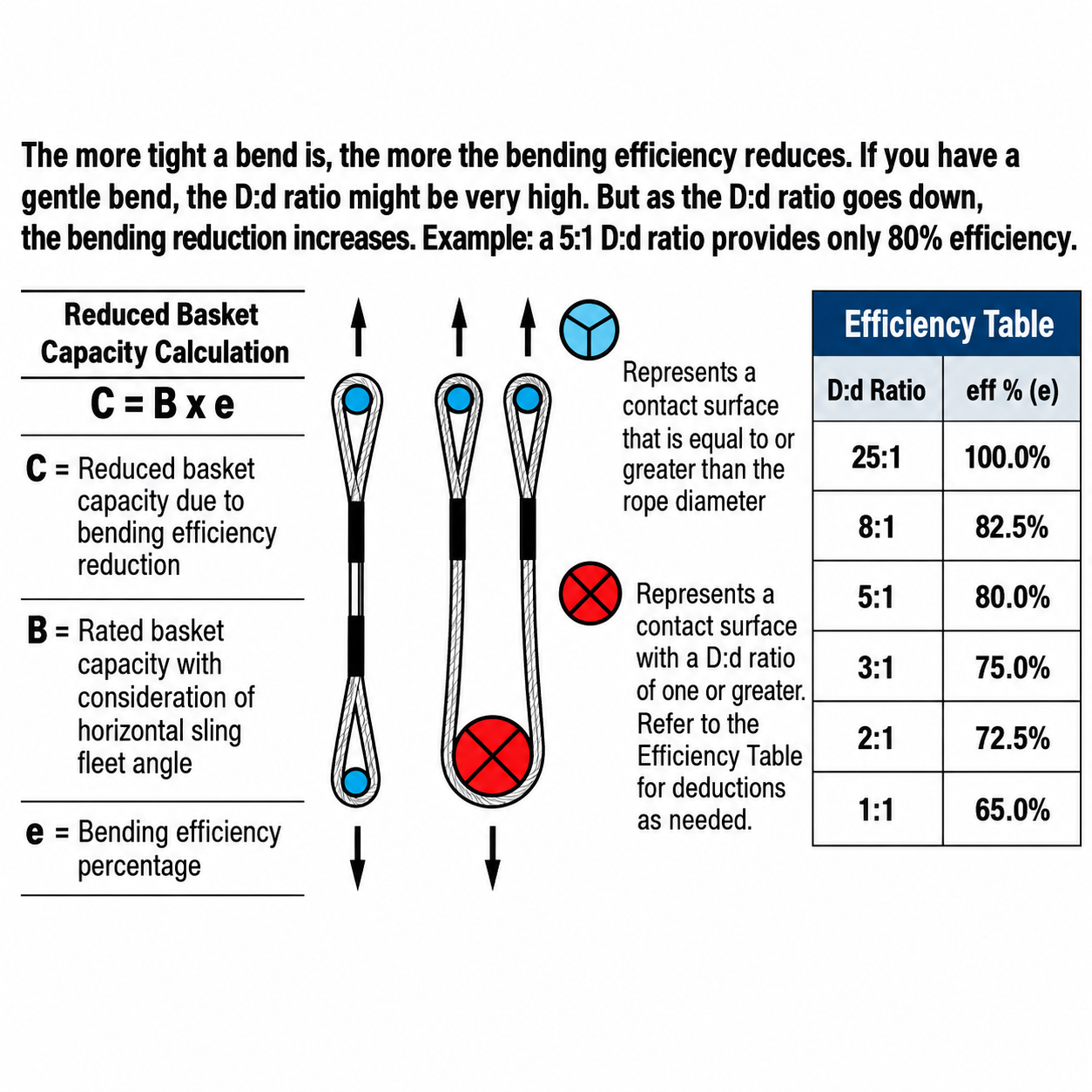
Wire rope is a good example of how a tighter bend affects performance.
In this Tailgate Talk, Bailey’s explains how wire rope efficiency changes at different D ratios.
Here’s how the efficiency changes in the example:
- 25:1 D ratio: 100% efficiency
- 20:1 D ratio: 92% efficiency
- 10:1 D ratio: 86% efficiency
- 5:1 D ratio: 75% efficiency
As the bend gets tighter, wire rope loses efficiency.
However, that doesn’t make wire rope the wrong choice.
Instead, operators need to understand how the connection affects its performance.
The goal is to choose the equipment for the job.
HMPE Sling Construction and Rigging Efficiency
However, material alone doesn’t tell the whole story. Bailey’s compared an HMPE eye-and-eye rope sling with an HMPE grommet rope sling. Both use HMPE fiber. However, their constructions are different.
As the bend gets tighter, the HMPE eye-and-eye sling loses efficiency faster.
Meanwhile, the HMPE grommet sling maintains more efficiency on the same connection.
Both slings use HMPE fiber. However, their different constructions affect how they perform.
That’s why sling construction matters, not just the material.
Rigging Efficiency Comparison at a 5:1 Ratio
At a 5:1 D and d ratio, the chain example discussed in this Tailgate Talk retains about 90 percent of its rated basket capacity. The HMPE grommet rope sling example maintains 97 percent efficiency at that same ratio.
That does not mean the HMPE grommet rope sling is always the better choice. It means those two rigging constructions respond differently to the same bend. The useful question is not simply, ‘Which one has the higher number?’ It is, ‘Which construction fits what I am trying to accomplish?’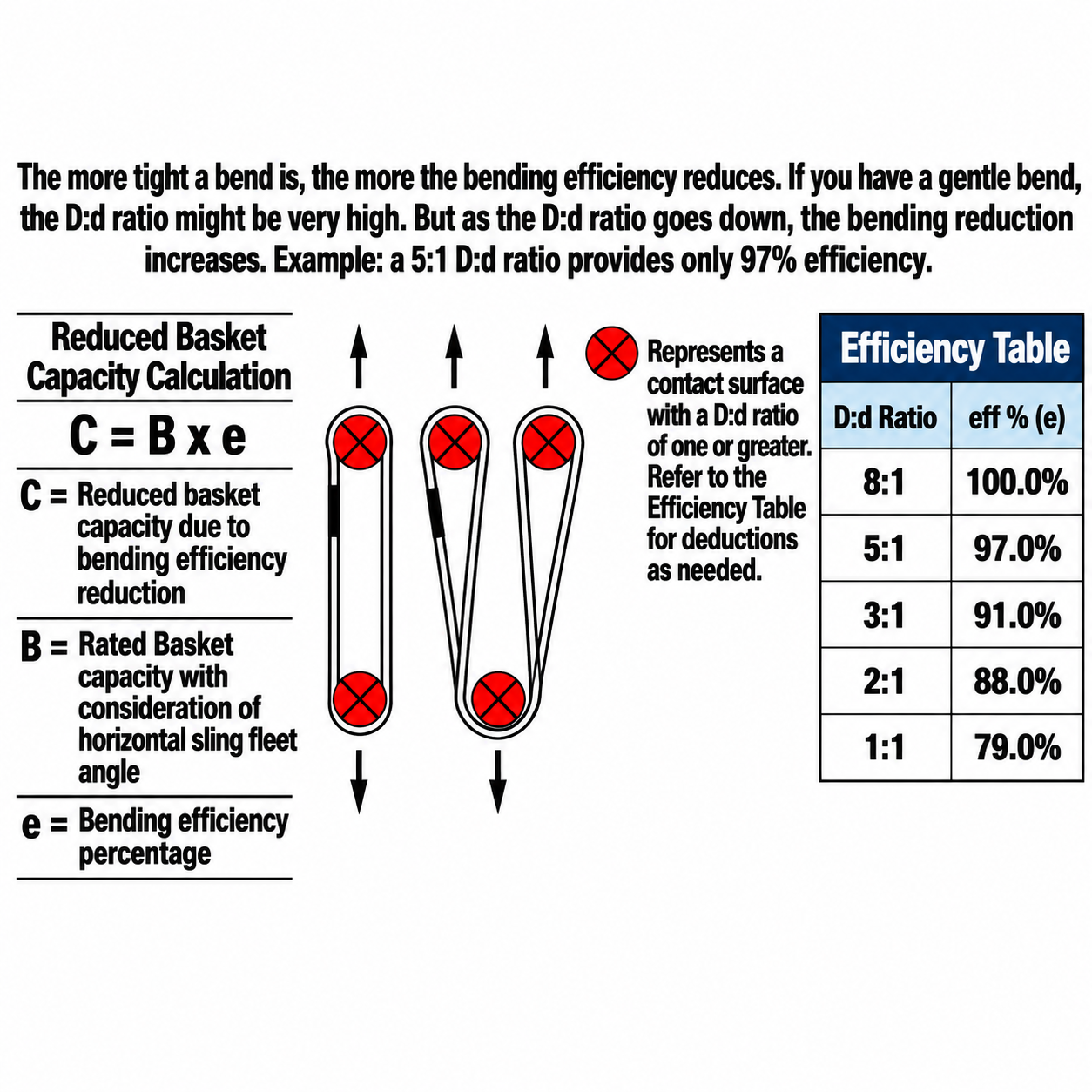
Choosing the Right Rigging for the Application
In towing and recovery, choosing rigging based on one number can leave out important parts of the picture. Working load limit matters. So does the connection. So do the material, construction, and the demands of the application.
Sometimes the right answer is chain. Sometimes it is wire rope. Sometimes it is synthetic rigging. Sometimes it is a combination. The goal is not to declare one material universally better than another; it is to understand how the complete rigging system behaves for the job in front of you.
That is why Bailey’s starts with the question, ‘What are you trying to accomplish?’ The tag starts the conversation. The application finishes it.
What Rigging Efficiency Comparisons Teach Us
Two rigging assemblies can carry the same working load limit and still respond differently on the exact same connection. D and d helps explain why, but the bigger lesson is to look beyond a single number and consider the material, construction, connection, and application together.
As a result, operators can make more informed rigging decisions without assuming that equal tags automatically mean equal performance.
Thanks for checking out Bailey’s Tailgate Talk — where cutting corners ain’t part of the job.
Bailey’s Tailgate Talk videos are posted on Bailey’s Towing Accessories, Inc. social media pages. Be sure to follow us for more towing, recovery, and rigging tips!
