
Bailey’s Tailgate Talk: Are You Looking at Sling Strength the Wrong Way
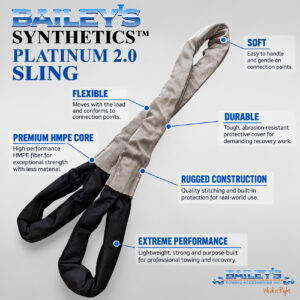
Open a tow truck toolbox and it doesn’t take long to see the problem: operators are carrying more rigging, more protection, and more hardware, but storage space hasn’t grown with it. Nobody wants to leave behind the one piece of recovery equipment they’ll need on the next call.
That’s where HMPE recovery slings are changing how operators think about sling strength. Traditional polyester round slings typically get larger as capacity increases, but high-performance HMPE fibers can provide comparable working load limits in a smaller, lighter package.
So, does a bigger sling always mean a stronger sling? Not necessarily. The material inside the sling matters.
Why Polyester Recovery Slings Get Bigger With Capacity
Many operators learned recovery rigging with polyester round slings. As capacity increases, those slings typically get larger as well. For years, needing more capacity often meant carrying a physically bigger sling.
That relationship between size and capacity can make it easy to judge sling strength by appearance alone. But high-performance fibers change that picture.
HMPE Recovery Slings vs. Polyester: What’s the Difference?
Traditional round slings are made with continuous loops of polyester yarn. High-performance round slings use continuous loops of HMPE fiber. Because HMPE is significantly stronger than polyester, less material is needed to achieve the same working load limit.
The practical result can be a sling that is roughly half the size and half the weight of a comparable polyester round sling with the same capacity. That difference can matter when an operator is carrying several sling capacities on the truck.
Bailey’s 20,000-Pound Platinum Sling Comparison
Bailey’s 20,000-pound Platinum Sling provides a useful example. It has the same working load limit as a blue polyester round sling, while its diameter is closer to the size of a green polyester sling.
The point is not that the larger polyester sling is somehow wrong. It is that physical size alone no longer tells the whole story about lifting capability. Different materials can provide similar capacity in very different-sized packages.


How Compact Recovery Slings Save Toolbox Space
A smaller, lighter sling can be easier to carry and handle, but storage may be the bigger issue. When several capacities are stored together, reducing the space each sling occupies can add up quickly.
That extra room can help operators keep other recovery rigging available, including corner protection, sleeves, and additional rigging options. When toolbox space is limited, compact equipment can affect what an operator is able to keep on the truck for the next recovery.
How Protective Covers Improve Sling Handling
These high-performance slings technically begin as endless round slings, but the custom-built protective cover effectively creates an eye-and-eye style sling. That design makes the connection points easier to identify and can make the sling easier to position, rig, and handle on scene.
The cover is intentionally sized to fit the sling rather than being oversized. This allows the sling to lay flat while providing built-in protection, and it also helps the sling fold into a compact package for storage after the job.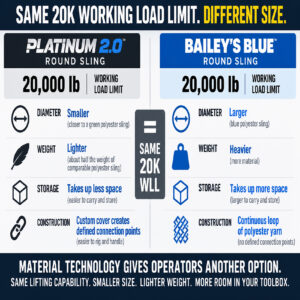
Why Length Can Matter:
Size and weight are not the only considerations. In heavier lifts, sling length can matter as well. A few inches can affect how a load hangs, sling angles, and whether the setup balances as intended. That is one reason high-performance slings may be selected for applications where exact lengths matter.
Protecting HMPE Recovery Slings From Damage
Higher-performance material does not eliminate the need to protect the sling. Sharp edges, pinch points, and other sources of damage still matter.
Bailey’s recommends corner pads and careful attention to sharp edges and pinch points. These slings also work well with urethane sleeves when additional protection is needed. Polyester or high-performance, no sling benefits from abuse.
The Better Question: Better at What?
The takeaway is not that bigger slings are bad or that one material should automatically replace another. Different pieces of towing rigging are designed to solve different problems.
When comparing slings, look beyond physical size. Consider the material, working load limit, handling, storage space, protection, length, and the demands of the application. As materials and recovery equipment evolve, understanding those differences helps operators make more informed rigging decisions.
The Bottom Line:
Strength does not always come from size. Polyester round slings and HMPE high-performance slings can provide different combinations of capacity, size, weight, handling, and storage. Knowing what the sling is made from – and what the application requires – gives you a better basis for evaluating the rigging in your toolbox.
Thanks for checking out Bailey’s Tailgate Talk — where cutting corners ain’t part of the job.
Bailey’s Tailgate Talk videos are posted on Bailey’s Towing Accessories, Inc. social media pages. Make sure you’re following us to stay updated!
For the full discussion and sling comparison, watch the corresponding Bailey’s Tailgate Talk video: Are You Looking at Sling Strength the Wrong Way
