
Bailey’s Tailgate Talk: Think All Slings Lose Strength the Same Way? They Don’t.
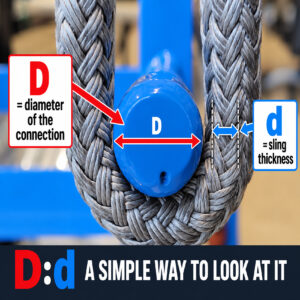
When a recovery sling fails below its rated capacity, it’s easy to assume something went wrong with the sling itself. But the real issue may be how it’s being used.
Understanding the D:d ratio for recovery slings is an important part of proper rigging.
The size of your connection point compared to the thickness of your sling can significantly affect sling efficiency and performance.
What Does D:d Mean?
The D:d ratio compares the size of what the sling is bending around with the thickness of the sling.
The big D represents the diameter or size of the connection point — such as a shackle pin, hook, or other connection point.
The little d represents the thickness of the sling.
Put those two measurements together and you have your D:d ratio.
For example, if the connection point and sling thickness are the same size, you have:
D:d = 1:1
That’s a very tight bend.
As the connection point gets larger compared with the sling, the ratio increases and the bend becomes more open.
Why Does the Bend Matter?
When a sling is bent tightly, the fibers don’t share the load in the same way they do when the sling has more room to wrap around the connection point.
The tighter bend can cause the sling to work against itself, which reduces its efficiency and can contribute to damage within the sling.
This is why looking only at the sling’s rated capacity isn’t enough.
The rating is based on the sling. Your actual setup determines how that sling is being loaded.
Seeing the Difference: 1:1, 3:1, and 5:1:
One of the easiest ways to understand D:d is to visualize what happens as the bend opens up.
At 1:1, the connection point is approximately the same size as the sling thickness.
That’s a tight bend, and you’re giving up a significant amount of strength.
Open that bend up to approximately 3:1, and the sling has more room to lay around the connection point. The sling begins to open up rather than being forced into such a tight bend.
Go farther to approximately 5:1, and the sling can lay much more naturally around the connection point.
The point is simple: as the D:d ratio increases, the bend becomes less severe.

Not All Slings Lose Strength the Same Way:
Here’s where things get especially important.
Not every sling design responds to a tight D:d ratio in exactly the same way.
The script for this Tailgate Talk gives an example of manufacturers showing eye-to-eye slings at approximately 65% efficiency at 1:1, while grommet-style slings are shown at approximately 79% efficiency at 1:1.
Those numbers are different because sling construction matters.
Eye-to-eye slings have defined connection points. The load transitions through the eyes, and the bend can concentrate stress in those areas.
Grommet-style slings are continuous. Their construction allows the load to be distributed more evenly through the body of the sling.
That difference in construction can affect how the sling responds when it is bent.
But there is an important point that should not get lost:
Neither sling is at full strength at a 1:1 D:d ratio.
A sling design may perform better than another under the same conditions, but that doesn’t mean a tight bend suddenly has no effect.

A Real-World Example:
Consider the five-eighths-inch Bailey’s grommet sling discussed in this Tailgate Talk.
In a basket configuration, with a proper D:d ratio, the sling is rated for 30,500 pounds.
Now change the geometry.
At a 1:1 D:d ratio, the grommet is around 79% efficiency based on the example in the video.
That puts the resulting capacity closer to approximately 24,000 pounds, rather than the full 30,500-pound rating.
That’s a significant difference caused not by changing the sling, but by changing the way the sling is being loaded.
Look at the Connection Point:
So how do you start thinking about D:d in the field?
Look at the sling and look at the connection point.
If they’re approximately the same size, you’re looking at a 1:1 D:d ratio.
For example, a one-inch sling around a one-inch pin represents approximately a 1:1 ratio.
That’s a tight bend, and even with a sling design that performs better under those conditions, you’re still not getting the sling’s full capacity.
Give the sling more room.
At approximately 3:1 or greater, the bend opens up considerably and the sling is able to perform more like it was designed to.
The basic concept is easy to remember:
Bigger connection point = more room for the sling to bend.
Tighter bend = reduced sling efficiency.
Design Matters, But Geometry Still Wins:
Sling construction matters.
Different sling designs can respond differently to the same D:d ratio, and the examples in this Tailgate Talk demonstrate that difference.
But geometry still matters.
A sling doesn’t get to ignore the D:d ratio simply because it has a particular construction.
That’s why operators need to consider both the sling they’re using and the setup they’re putting it into.
The question isn’t simply, “What’s the rating on this sling?”
The better question is, “What is the setup doing to that sling?”
Give the Sling Room to Work:
The takeaway from D:d is not complicated.
When the connection point is too small compared with the sling, the bend becomes tighter. When the connection point gets larger, the sling has more room to wrap around it.
That is why the Tailgate Talk emphasizes going bigger where it matters: larger shackles, better connection points, and a cleaner load path can give the sling more room to work.
The goal is to let the sling wrap rather than fold.
And don’t assume that the number printed on the sling automatically represents the capacity of every possible setup.
The sling’s rating doesn’t change.
Your setup does.
The Bottom Line:
-D:d ratio is one of those rigging details that can be easy to overlook because the sling itself hasn’t changed.
-But the way that sling interacts with the connection point can change how it performs.
-A 1:1 ratio creates a tight bend and reduces efficiency. Increasing the ratio gives the sling more room to work. And while sling construction affects how much strength is lost, no sling should be assumed to operate at full strength simply because its rated capacity says so.
-Understand your sling.
-Look at your connection point.
-Check the D:d ratio.
– Make sure the setup you’re about to load gives the sling the room it needs to perform as intended.
Thanks for checking out Bailey’s Tailgate Talk — where cutting corners ain’t part of the job.
If you want to go deeper on rigging, Bailey’s Towing Accessories encourages operators to keep asking questions and learning about the equipment they trust every day.
For a closer look at D:d ratio and the examples discussed here, watch the Bailey’s Tailgate Talk video: Think all Slings lose Strength the same way? They dont.